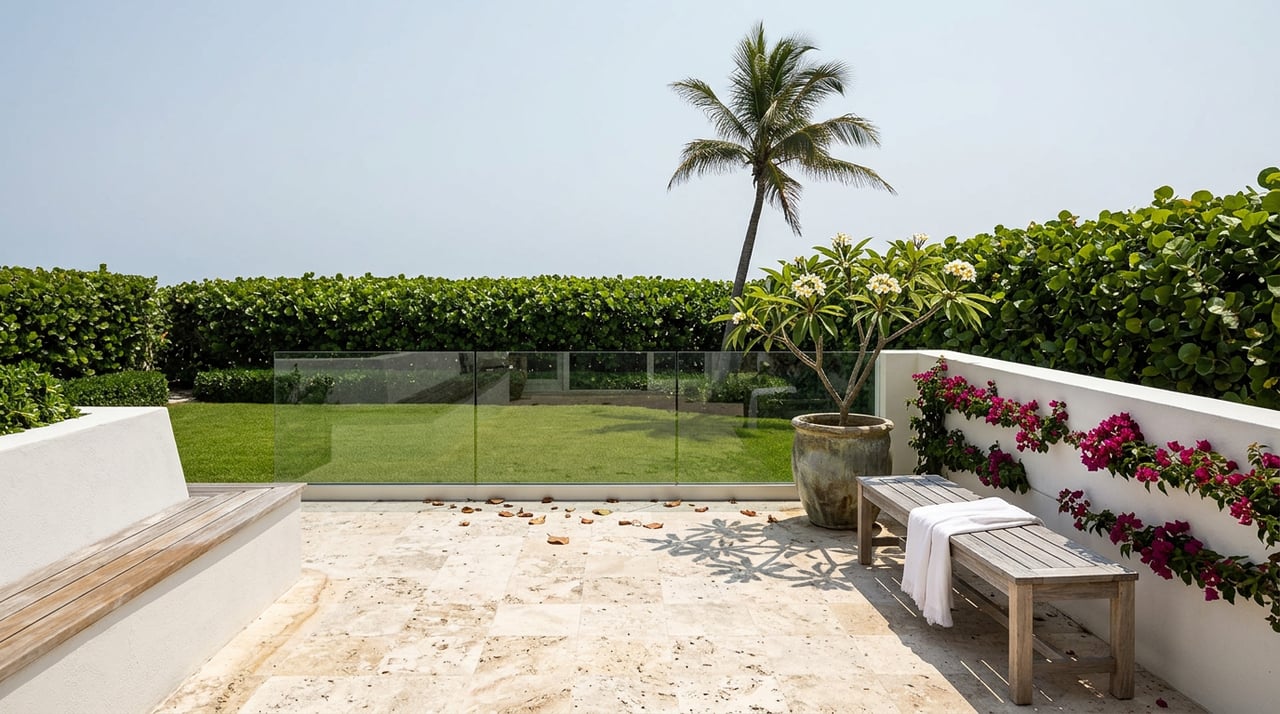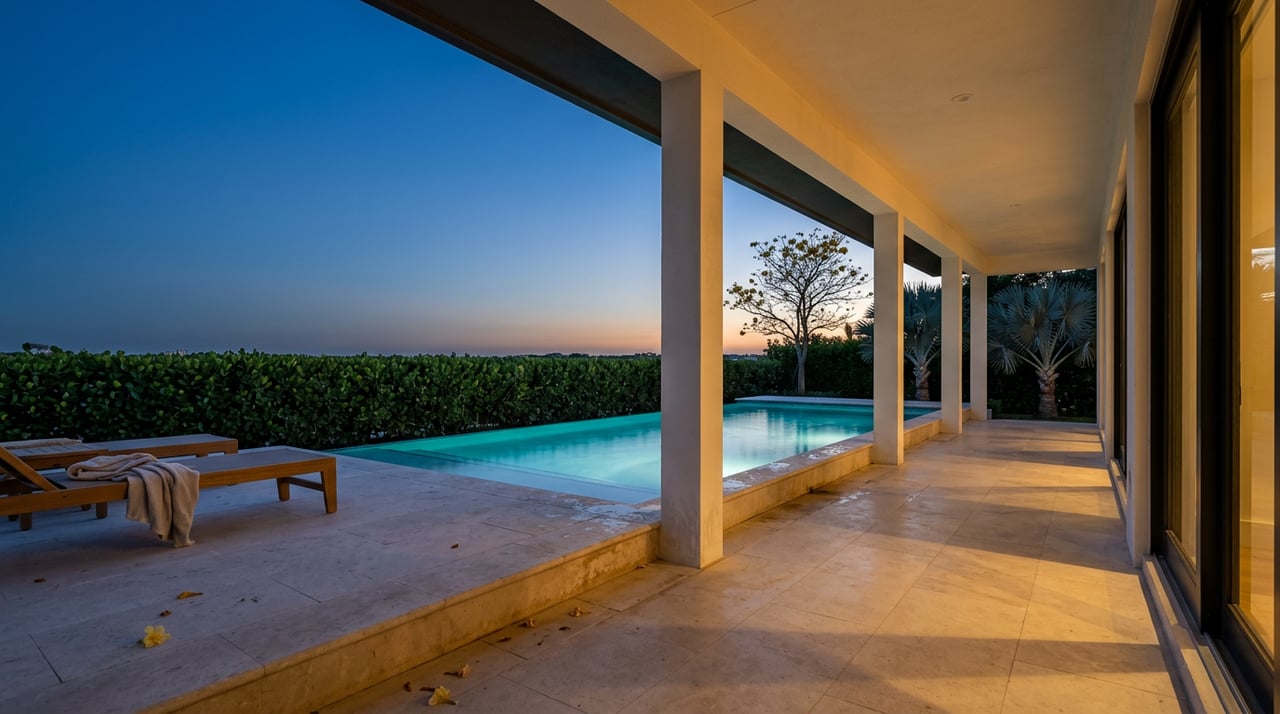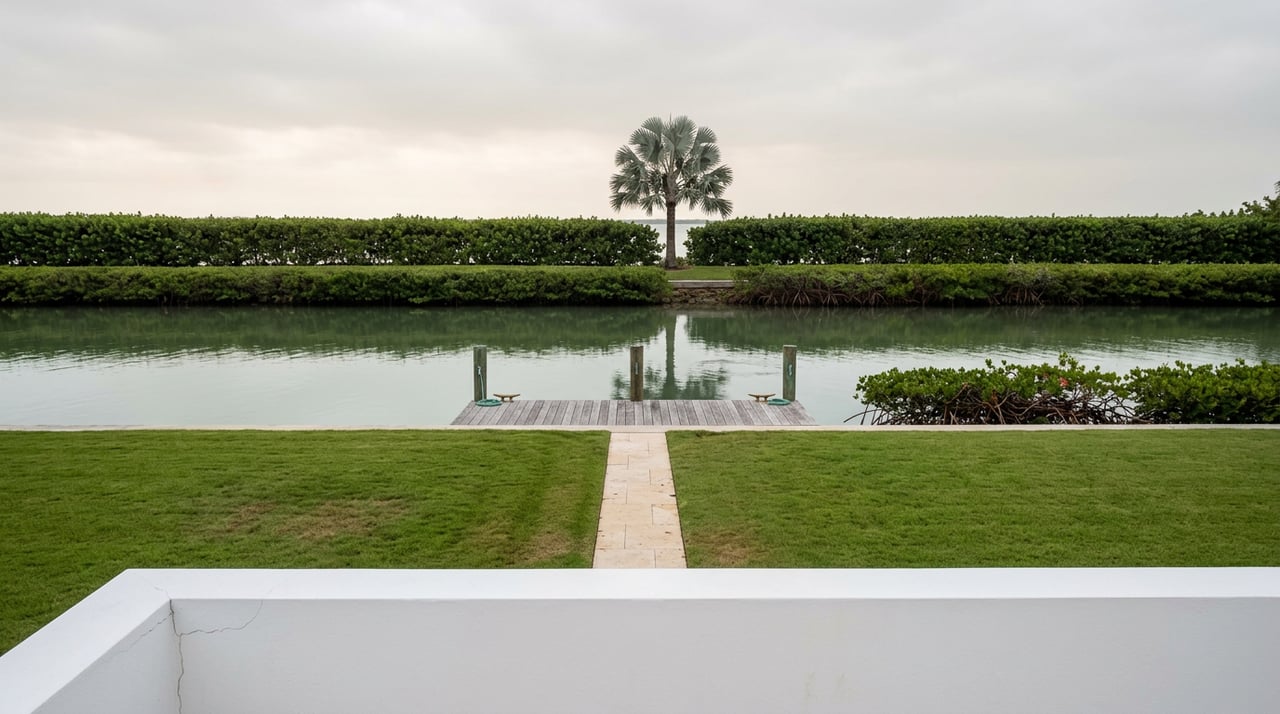
Every description of Old Fort Bay starts the same way. Canals winding through the neighborhood so that almost every house touches water. A dock behind nearly every lot. Step off your veranda, onto your boat, gone in minutes. It reads like the whole community is one continuous stretch of water that belongs equally to everyone who owns a piece of it.
That picture is mostly true, and also legally incomplete. A 2022 Bahamian court judgment drew a line straight through the water that every resident who has tried to tie up at the marina for a quick lunch has already felt, even if nobody explained it to them in those terms. The canals you motor through on a Tuesday afternoon are common property, held in trust for the whole community. The Club and the marina where you'd actually want to dock and eat are not. They are separate ground, and getting from one to the other is where the neighborhood's real texture lives.
The Route Past Five Islands
Anyone who has taken a boat out from a canal-front dock in Old Fort Bay knows the route by feel before they know the names. The marina sits at the center of a small archipelago inside the community: Charlotte Island, Arbor Island, Dunmore Island, Montagu Island, and Fincastle Island, with the channel opening toward Ocean Drive before it meets open water. It is not a long run. It is the kind of stretch you can do slowly, with a coffee in the cup holder, past neighbors' docks and mangrove edges that the original subdivision plan deliberately preserved rather than dredged flat.
That preserved mangrove line matters more than it looks like it should. It is part of why the canals feel more like a quiet backcountry cut than a marina channel, even with yachts tied up a few docks down. The five islands are not a marketing flourish. They are the actual geography a resident learns to read within the first few weeks of owning a boat here, the same way you learn which turn floods at high tide or which dock light burns out first.
What the Judgment Actually Separated
Here is the part that surprises people who assumed the whole waterway system worked the same way everywhere. The 2022 judgment held that the canals, the waterways, the boat basin, and part of the beach reserve are common areas held on trust for the Property Owners' Association. The Old Fort Bay Club and its marina are not. They sit outside that trust.
In plain terms, this means two different things are true on the same afternoon. You can take your boat anywhere in the canal system, because that water belongs to the community collectively and your lot gives you a share of it. But pulling up to the marina to tie off before walking into the Club for lunch is a different transaction entirely. That dock space and that clubhouse belong to a separate entity with its own membership process, its own fees, and its own waiting list logic. Owning a canal-front lot gives you the water. It does not automatically give you the slip.
The canal you're floating on is yours by trust. The dock you want to tie up at for dinner is someone else's gate.
Residents who have lived here long enough tend to absorb this distinction without ever hearing it phrased as a legal finding. They just know that some Saturdays the marina fills up with member boats before noon, and that the empty slip near the fuel dock isn't actually available to whoever gets there first. The judgment is the reason why.
The Rules That Come With Shared Water
Because the canals are common trust property rather than a private amenity, the Property Owners' Association governs how everyone uses them, not the Club. The working rules are straightforward but specific enough that they shape the rhythm of a normal week on the water.
- Boats and docks must be registered with the POA, and dock structures have to comply with the Architectural Code, not just whatever a builder proposes.
- No-wake speed applies throughout the canals and waterways, which is why a slow Tuesday motor past Dunmore Island takes longer than the distance suggests.
- No refueling is permitted at private docks, which pushes fuel runs out to commercial marina infrastructure rather than a garden hose and a jerry can behind the house.
- Every vessel using the canals is expected to be seaworthy and insured, and the canals themselves cannot be used for commercial purposes, which keeps charter operations and delivery traffic off water that residents share.
None of this is dramatic. It is the kind of ordinary friction that governs any commonly held resource used by two hundred to three hundred households at once. But it explains why a resident's Tuesday looks different from a renter's assumption of what "canal access" means. The water is shared, and shared water comes with shared rules that nobody writes into a listing description.
The Beach Reserve Nobody Fully Owns
The same 2022 judgment touched the beach too, and this is the part that catches people off guard on a sunny Sunday. Old Fort Beach is often called the prettiest stretch of sand on New Providence, and the official Bahamas tourism site describes members arriving early to walk it before the day gets warm. Part of that beach falls under the same common-area trust as the canals. But the judgment also found there are no conveyances providing universal beach access across every lot in the community.
That distinction plays out quietly. Walk the beach on any given morning and you will notice some stretches feel more populated with regular faces than others, while sections near certain lots stay consistently quiet. It is not about who is friendlier. Beach rights in Old Fort Bay are reviewed lot by lot rather than assumed community-wide, which means two neighbors on the same street can have meaningfully different relationships to the same shoreline.
A Week on This Water
Put the pieces together and a normal week here starts to make more sense than the postcard version. Monday morning might mean a slow run past Charlotte and Arbor Islands with nowhere in particular to be, no-wake the whole way because that is simply how the canal works, not because anyone is watching. Wednesday could be a fuel stop at the marina's commercial dock rather than at home, because that is where fueling actually happens. Friday evening is the night the marina slips fill early, because Club members with dinner reservations get there first and the dock space belongs to the Club, not to the canal system at large.
Saturday morning on the beach might mean walking past a stretch that always seems to have the same family's chairs set up, not because they are unfriendly but because that section sits within their lot's documented access. And Sunday, if the household includes a POA-registered boat and dock, might close with a slow return past Fincastle Island and Montagu Island, back to a private dock that is legally part of a trust shared with every other homeowner on the canal, even though it feels entirely private from the deck.
None of this makes Old Fort Bay less appealing. If anything, it makes the place more legible. The water here is genuinely shared in ways that most gated communities never bother to define this clearly, and the parts that are private are private for a documented reason rather than an assumption. Residents who understand where the line actually falls tend to plan their weeks around it without friction. The ones who don't are the ones surprised when the marina is full on a Friday they didn't book ahead.
For residents who want the fuller picture of how club membership, dock rights, and POA governance fit together, Chancellors KW Bahamas has put together a deeper look at how ownership and club access actually interact in Old Fort Bay. If you are weighing a move within the community, adding a dock, or simply want a clearer read on how the water here is actually divided, our team is glad to walk through it with you. Schedule Your Concierge Consultation with Chancellors KW Bahamas whenever you are ready.