Choosing between Eleuthera and Exuma is not just a location decision. For resort developers, it is a strategy decision that shapes your product, infrastructure plan, staffing model, and exit potential. If you are weighing where your concept fits best, this guide will help you compare the two through a practical development lens and clarify why Eleuthera often stands out for certain resort plays. Let’s dive in.
Why the Eleuthera vs. Exuma choice matters
Eleuthera and Exuma both operate within the same premium Bahamian tourism ecosystem, but they support different types of resort development. Based on the current official source set, Eleuthera generally aligns better with phased boutique, wellness, eco, surf, and mixed residential-hospitality concepts.
Exuma, by contrast, more often fits ultra-luxury, yacht-oriented, private-island-style, and larger branded resort projects. That does not make one island better than the other in absolute terms. It means your concept, scale, and operating model should drive the decision.
Eleuthera at a glance
Eleuthera is a long, narrow mainland island that official tourism materials describe as about 180 kilometers long and as little as 1.6 kilometers wide in places. It is served by three airports: North Eleuthera, Governor’s Harbour, and Rock Sound. That creates a more distributed access pattern than many developers expect.
For resort planning, that geography matters. Instead of one dominant arrival story, Eleuthera functions through northern, central, and southern nodes, which can support phased development, different guest experiences, and site-specific positioning.
Eleuthera’s brand is low-density and experiential
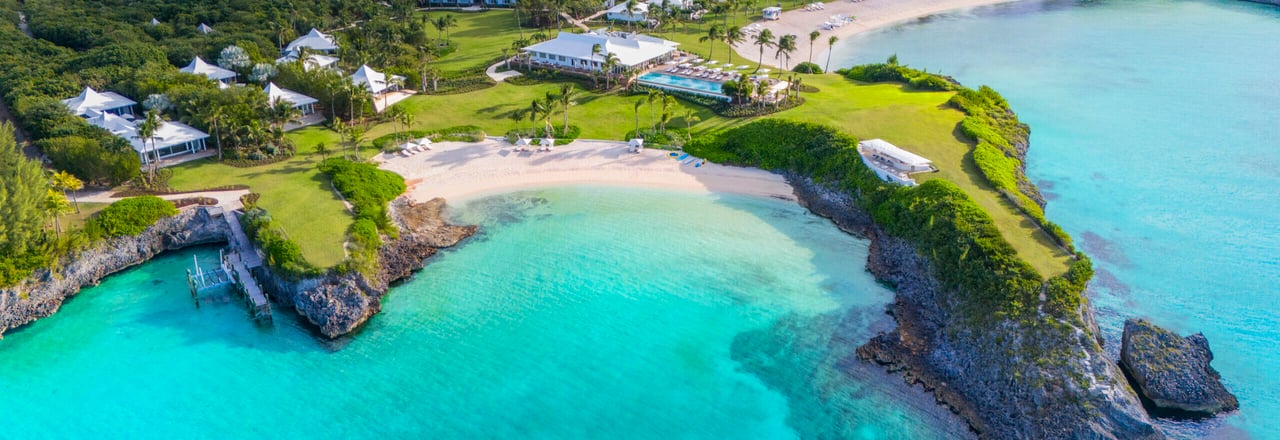
Official destination messaging emphasizes more than 100 beaches, surfing, reef and wreck diving, island hopping, and a mix of casual and elevated dining. It also includes Harbour Island and Spanish Wells in the broader destination narrative, which expands the lifestyle appeal around the mainland island.
That brand profile tends to support projects that feel place-based rather than heavily standardized. If your vision depends on privacy, nature, design, and a more relaxed luxury story, Eleuthera gives you room to shape that identity.
Eleuthera supports boutique and residential crossover
Eleuthera had a reported population of 8,202 in the official census reporting cited in the research, compared with 6,928 for Exuma and Cays. Both are small labor markets by resort standards, but Eleuthera’s larger resident base can be relevant if you are planning a project with a phased staffing model or a mixed residential-hospitality component.
Its mainland layout and three-airport access pattern also make it easier to think in stages. For many developers, that opens a path for boutique resort product, branded residences, villas, or second-home inventory that can be absorbed over time.
Exuma at a glance
Exuma is a 365-island chain with Exuma International Airport on Great Exuma as the primary gateway, while Staniel Cay serves as an official port of entry in the cays. The destination has a stronger boating and ultra-luxury identity in official tourism messaging.
The guest profile is also more clearly defined. Exuma is marketed around secluded beaches, charter boats, sandbar exploration, and ultra-exclusive resorts, which helps support premium pricing and destination-resort positioning.
Exuma has stronger visible institutional momentum
Government messaging around the redevelopment of Sandals Emerald Bay into Beaches Exuma signals a major capital-market story. The reported figures include a $100 million transformation, 850 eventual jobs, and more than $1.5 billion in investments underway across Exuma.
For developers, that creates a strong signal. If your strategy depends on luxury brand recognition, high-touch service, and a market already attracting large-scale resort capital, Exuma offers more obvious momentum today.
Access and logistics comparison
Access can shape everything from construction sequencing to guest arrival patterns. Here, Eleuthera and Exuma solve different problems.
Eleuthera offers distributed access
Eleuthera’s three-airport structure gives developers more than one gateway option. Governor’s Harbour, North Eleuthera, and Rock Sound all support IFR and VFR operations, and port-of-entry functions vary by site.
That can be helpful if your project is site-specific and you want to align access with a particular part of the island. It also supports the idea of Eleuthera as a collection of submarkets rather than one single resort corridor.
Exuma offers a more concentrated gateway
Exuma’s access pattern is simpler and more centralized, with Exuma International Airport as the main gateway and Staniel Cay serving the cays. For larger branded resorts or marine-driven concepts, that concentration can make the arrival story easier to communicate.
If your operating model depends on a clear primary gateway and strong boat-based guest movement, Exuma may feel more straightforward. If your concept benefits from multiple nodes and a broader mainland footprint, Eleuthera often has the edge.
Labor and operating scale
Neither island should be viewed as a deep labor market. Workforce planning is essential in both places.
Exuma’s resort economy highlights the staffing intensity of large projects. Government reporting notes that the Beaches Exuma redevelopment is expected to employ 850 people, and that 425 Bahamians already worked at Sandals Emerald Bay, with about 200 from Exuma.
For developers, the lesson is simple. Whether you choose Eleuthera or Exuma, workforce housing, training, transport, and retention should be built into the plan from the start.
Utilities can influence project risk
Utility capacity and reliability are often the difference between a smooth opening and a difficult one. The current public information suggests an important distinction between the two islands.
Eleuthera has broad water reach but power transition risk
The Water and Sewerage Corporation says Eleuthera is supplied to all sectors of the island, mostly from desalination, with the Bogue wellfield still used in the north. Reported daily production is 1.1 million imperial gallons across 5,100 accounts.
On power, the picture is less settled. Bahamas Power and Light describes an active grid revitalization program in Eleuthera, while recent releases document outages and feeder faults. For a developer, that points to a near-term transition and repair cycle that should be reflected in infrastructure planning.
Exuma shows more visible generation headroom
On Exuma, the Water and Sewerage Corporation says supply is provided by reverse osmosis on Great Exuma and selected cays, centered on George Town, with daily production of 323,000 imperial gallons and 1,650 accounts. BPL reports 26 MW of generation capacity, 16.5 MW available, and a recent peak load just under 7 MW, with a hybrid plant targeted for the first quarter of 2027.
That does not remove infrastructure risk, but it suggests Exuma currently has more visible power headroom. For larger, energy-intensive resort concepts, that may matter.
Entitlements and environmental review
No matter which island you choose, approvals are structured and condition-based. This is not a market where informal assumptions should drive your timeline.
The Planning and Subdivision Act requires island land-use plans, connects subdivision approval to roads and utility provision, provides for public hearings, and allows approvals to lapse if substantial development does not begin within the approval window. DEPP also states that environmental impact assessments and environmental management plans are required for industrial, commercial, and residential developments throughout The Bahamas.
Exuma often has a denser marine-permit overlay
Exuma carries a heavier protected-area footprint, especially for cay and marine development. The Exuma Cays Land & Sea Park covers 112,640 acres, and Moriah Harbour Cay National Park protects 22,833 acres.
That does not mean Exuma is off-limits. It means marine and cay-based development often comes with a denser permitting conversation and more site-specific diligence.
Eleuthera still requires careful site review
Eleuthera’s conservation footprint is smaller, but it is still significant. The Leon Levy Native Plant Preserve is a 30-acre national park, and Seahorse National Park at Sweetings Pond and Hatchet Bay Cave adds both terrestrial and marine sensitivity to the island’s development context.
The practical takeaway is straightforward: neither island should be treated as low-friction. In Eleuthera, the conversation may be more localized around terrestrial and coastal sensitivity, while in Exuma it is often more marine-focused.
Which resort concepts fit Eleuthera best?
If you are evaluating Eleuthera specifically, the current source set points to several strong strategic fits.
Boutique eco and wellness resorts
Eleuthera’s tourism identity is built around beaches, reef access, surf, and lower-density experiences. A Bahamas Ministry of Tourism sustainability feature also used Eleuthera as an example for upscale glamping, citing The Other Side as a solar-powered beachfront and hilltop tented concept.
That makes Eleuthera a compelling choice for wellness-led, sustainability-conscious, or design-forward boutique resorts. These concepts can align naturally with the island’s current brand rather than trying to force a different one.
Surf, fishing, and nature-led lodging
Because official destination messaging already highlights surfing, wrecks, reefs, and island hopping, activity-based resort concepts can feel very credible in Eleuthera. If your project is built around experience rather than scale, the island offers a strong storytelling platform.
This can be especially useful when your guests are privacy-seeking, second-home oriented, and interested in repeat travel rather than one-time destination spectacle.
Mixed residential-hospitality projects
Eleuthera’s larger resident base, three-airport access, and distributed settlement pattern support phased resort communities with residential spillover potential. If your strategy includes villas, branded residences, second-home inventory, or a slower absorption schedule, Eleuthera often gives you more flexibility.
That can make it attractive for developers who want multiple exit paths rather than relying solely on hotel performance.
A practical decision framework
If your concept centers on ultra-luxury branding, boating, private-island-style appeal, or a large all-inclusive model, Exuma may be the stronger fit, especially if you can solve workforce housing and staffing logistics.
If your concept centers on low-density luxury, boutique positioning, surf or wellness demand, eco-sensitive design, or a residential-hospitality blend, Eleuthera is often the better strategic match. It offers a more place-based identity and a physical layout that supports phased development.
In short, Eleuthera is usually the stronger answer when you want to build with the island rather than build over it. Exuma is often the stronger answer when you want to plug into an already legible luxury-resort narrative.
If you are evaluating resort land, development acreage, or a phased hospitality concept in Eleuthera, the right advisory partner can help you assess access, utility conditions, entitlement sequencing, and product-market fit before you commit capital. To discuss opportunities with a local, development-aware team, schedule your concierge consultation with Chancellors KW Bahamas.
FAQs
Is Eleuthera or Exuma better for a boutique resort developer?
- Eleuthera is generally the better fit for phased boutique, wellness, eco, surf, and mixed residential-hospitality concepts based on current official destination branding, access patterns, and development characteristics.
Is Exuma better for large branded resort projects in The Bahamas?
- Exuma is generally better suited to ultra-luxury, yacht-oriented, private-island-style, and larger branded resort plays, with strong current investment signals and a more established luxury-resort identity.
Does Eleuthera have enough access points for resort development?
- Eleuthera has three airports, North Eleuthera, Governor’s Harbour, and Rock Sound, which creates a distributed access model that can support different development nodes and phased projects.
Are utility conditions different in Eleuthera and Exuma?
- Yes. Public reporting suggests Eleuthera has broad water service coverage but remains in a grid revitalization and repair cycle, while Exuma currently shows more visible power generation headroom.
Do resort developers need environmental approvals in Eleuthera?
- Yes. Under Bahamian planning and environmental rules, industrial, commercial, and residential developments require structured approvals, and environmental impact assessments and environmental management plans are required.
Is Eleuthera a good fit for mixed residential and hospitality development?
- Yes. Based on the current source set, Eleuthera’s larger resident base, mainland layout, and three-airport access pattern make it a strong candidate for phased projects that combine resort and residential components.